Dear visitors,
Linda here — your newsletter layout editor, website designer, and the newly (self-)appointed Creative Director for Postcards to the Front. I should like to introduce you to something new on our homepage: Postcard Constellation, a web-based interactive exhibition for this project.
Where the idea came from
The idea is borrowed, and I am happy to say so. Since 2022 I have been running Stamp Out War: Support Ukraine!, a philatelic humanitarian art project with a far more specialized bent and, inevitably, a rather niche audience. For a long time I wanted to mount a physical installation for it: the maxicards my global team created, displayed alongside an interactive program that would visualize the trajectories those maxicards had traveled, together with interviews about who the participants are and how they came to be involved.
That grant application to the Canada Council for the Arts was declined, and so, in want of funding, the physical installation may never take place.
But I didn’t want the idea of interactivity to go to waste — and the longer I thought about it, the more convinced I became that Postcards to the Front stands to benefit from it far more. This is a much more human-oriented project. The cards matter, but the people on either end of them matter more, and connection between people can genuinely be the focus here in a way it could not be there. So over the course of about a week, with the help of the AI service I had recently subscribed to for several of my personal projects, I built the thing I had been imagining — with a few twists to fit the Postcards to the Front model.
Why not simply a blog post?
I have found the blog format too limiting for what we are trying to do. We can embed maps, images and YouTube videos, certainly — but embedding is not the same as integrating, and a page of separate embedded objects is neither intuitive nor especially fun.
Consider a single sentence: this card traveled from Singapore to Canada, and from there to Ukraine. On paper it is a line of text you skim past. On a 3D globe, that same journey becomes a long, animated arc you can watch being drawn — and suddenly it is an education in world geography, particularly for younger visitors. The information was always there. Interactivity is what makes someone want to receive it.
That is the wager behind this whole exhibition: if we make things visually appealing and intuitively enjoyable, more people will be willing to read the interviews, listen to the voices, and sit with the stories we have gathered.
A second reading
There is another reason, and it is one that has been quietly bothering me for some time.
We work hard on each issue of the newsletter. But a newsletter is read once, if we are lucky, and then it is set down. Our archive keeps growing — which is a good problem to have, and also a real one, because the larger it becomes, the more daunting it is for anyone to go back and dig out a particular article. Stories we spent weeks gathering end up sitting where nobody will stumble across them again.
The exhibition is my attempt at an answer. Every second month, a new constellation brings forward a group of postcard warriors we have written about before, gathered together by something they share. Their stories return to the surface, in new company and in a new light. Nothing we publish has to be read only once. And no story stands alone. It is but one star in the constellation of stories about Ukraine; particularly, about the relationships our postcard warriors have with Ukraine, with their understanding and support of Ukraine.
The language of the night sky
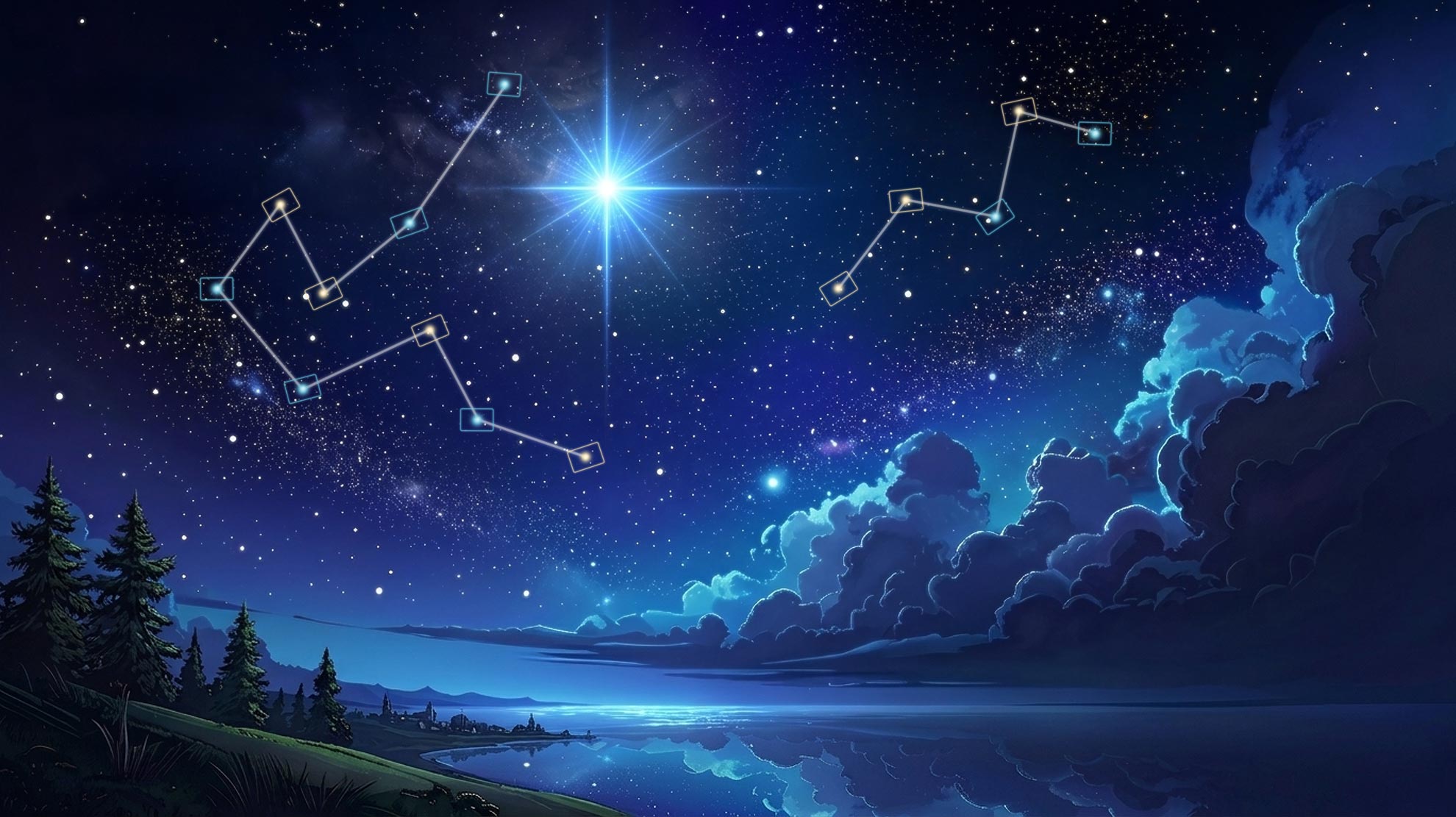
The exhibition is curated in the visual language of the night sky.
Every postcard becomes a starlight, shining against the dark of night. The trails these lights leave behind illuminate a world otherwise smothered by the darkness of war. That image is the heart of the presentation — not decoration, but the argument itself.
(For practical reasons I have added a button to toggle the daylight texture on and off, in case the night globe is not clear enough for some visitors. But the night is where this belongs.)
The three modules
Trails is the 3D globe. It animates the journeys our mails have taken — shown as direct arcs only, since the true mail routes are complex and largely unknown — each trajectory drawn across the surface of the earth, from wherever a card was written to wherever it was ultimately received. Two kinds of stars share that sky: our postcard warriors, in yellow, and the Ukrainians who have shared their stories of living through war with Postcards to the Front, in blue.
Constellations moves into abstract space. Here each postcard warrior curated for that bimonthly edition occupies a point, like a star in the universe, and forms different constellations with the others according to what they have in common — and the Ukrainians whose stories anchor that edition take their place too, still glowing blue among the yellow. Different shared attributes produce different constellations. The shape of the community changes depending on what you ask of it.
Starlights is a gallery of Defenders holding these sources of light — and it, too, is programmed in the language of illumination. Hover over a photograph, and it lights up.
The connectivity theme, and a guessing game
Each edition carries a connectivity theme — an attribute shared across the constellation currently on display. The theme itself is the subject of a guessing game: visitors are invited to work out what these warriors have in common.
The rhythm runs like this. Guesses close on the 20th of every second month. In the weeks that follow, while the team is at work on the upcoming issue of the newsletter, we post the answer here on our website, draw a winner from the correct entries, and notify them by email. The winner is then announced publicly, too — in that newly published newsletter issue and here on the website — under whatever name they would like to be known by: their own, or simply “anonymous,” if they would rather not be named. Then, with the release of the newest newsletter, a fresh constellation goes up in the sky, and the guessing begins again.
I should add, for anyone wondering: the entire database on which this exhibition is built is drawn from our own newsletter and blog content. Everything in it has already been published. No privacy concern here.
What I hope it does
This has a genuine educational component, and it works in two directions — it informs, and it calls people to act.
The 3D globe gives a visual, accessible, easy-to-read representation of the global connectivity that defines this project. For our visitors, that matters: our supporters value the international character of what we do, and now they can see it rather than take it on faith.
From the perspective of Ukraine, a visual representation of the expanse of global support — arcs of light crossing the sky in place of bomb trajectories — may be a genuine morale-booster for the Defenders, and for everyone at home.
Please share The Postcard Constellation with educators. I suspect it may generate classroom or school-based involvement in ways none of us can foresee.
And in the end
My ultimate wish, as an artist, is to put forward a physical exhibition for Postcards to the Front somewhere in this world — of which this interactive set-up would be a part. That day may still come.
For now, I am perfectly happy to stay with the online model, and perfectly happy that these particular stars are visible from anywhere with a screen.
Come and look up.
— Linda

A little bit about myself:
I am Linda — newsletter layout editor, website designer, and newly (self-)appointed Creative Director for Postcards to the Front, a title I awarded myself sometime this summer and have not yet been asked to relinquish. I also work at a postal counter in Montreal, where I have designed pictorial cancellations for several local post offices — Le Devoir wrote about that work, if you’re curious what art can look like in a postmark. I am also a long-distance touring cyclist, a visual artist, and an ex-mathematician who somehow ended up making maxicards. I run Stamp Out War: Support Ukraine!, the philatelic humanitarian project that first taught me how much a small object carried a long way can mean — this newsletter asked me about it back in Volume 1, Issue 3. Most the visual representation you see on this website — the layout, the globe full of light — I conceived myself and built with the help of AI, on the conviction that the stories this project gathers deserve to travel as far as the cards do. More of my work lives at lindasartworld.ca.
Your turn
Send a postcard of your own
Every card written in Canada reaches a defender in Ukraine. Here is exactly how to write and mail yours.
← Previous story
Next story →
From the mailbag
2 responses
-
This is Amazing! Thank you for all you are doing in support of Ukraine 🇺🇦🇺🇦🇺🇦
-
Thank you for your positive feedback Elizabeth! We are very grateful for the creative work of Linda, our newsletter layout editor and creative visionist!
-


Leave a Reply