Many of our supporters find us through an online search.
Such as Rachael, a writer who lives in the United Kingdom.
Rachael’s local church community has welcomed attendees from all over the world, some of whom are Ukrainian and have family and friends in Ukraine or Russia.
“Our community has all walks of life, and I really respect how my hometown and local clergy have welcomed refugees and have given them a second home and community in the UK.”
Over the last few months, Rachael has been knitting items to send to an organization that helps Ukrainian children and families who have escaped the occupied territories.
Some time ago, she sent a box of bought supplies (hats and gloves, emergency foil blankets, etc.) to Save Ukraine, the organization that helps rescue children and families from the front lines and occupied territories.
“Sadly,” she reported, “that parcel has been declared lost in the mail. After not being able to find an alternative address to send my knitted items for them, I made the decision to donate money directly, so they can directly get the supplies they need to support rescued children and families.”
Since her parcel for Save Ukraine was lost in transit, Rachael now donates her knitted items to the Yorkshire Aid Convoy, a UK-based organization that transports supplies to Ukrainian civilians, as well as has donated some knitted items (including adult-sized wool beanies) to New Forest For Ukraine, a UK-based charity that sends supplies to Ukrainian civilians and to Ukrainian soldiers.
Rachael has also knit wool hats and blankets to send to Ukrainian Defenders, telling us that she “was inspired by the women during WW2 who knit socks for soldiers, and I heard about the Zigrii movement in Ukraine, where women knit socks, hats, gloves, etc. for Defenders so they can stay warm in the winter.”
She added, “I knit on my own at home; I found Zigrii through YouTube when searching for places that accept knitting for Ukrainian Defenders and civilians. It inspired me to look for charities/organizations that accept knitted items.”
Lately, Rachael has started to learn how to crochet gloves and socks.
This handiwork “feels very rewarding knowing that it will go to people who need them. It gives me comfort to know that a blanket I make could bring a child comfort or keep a baby warm and cozy or keep a soldier warm in the cold trenches.”
The work that she does with her hands has become important to Rachael because it counters that feeling “… that because we live so far away, there’s simply nothing we can do.”
As we all learn once we apply thought to action, there’s always something that one can do. Size and monetary value are not what’s most important. Intentional care and meaningful support are.
Rachael expressed what many postcard warriors tell us: “I wanted to do something for a long time but simply didn’t know where to start. Seeing how the energy sector was [terribly] damaged in Ukraine, leading to power outages during Ukraine’s coldest winter in years, that kicked everything into action. I can make baby blankets and hats [and realized] I couldn’t just sit there and not use those skills, knowing they could help keep someone warm; if not for this winter, then the coming one.”
Rachael also shared that she’s “a firm believer that what may be a small effort for me can make a huge difference for someone else. It can be the difference between someone staying warm after the power has been destroyed because of drone attacks. It can help bring comfort to a child after experiencing what no child should. It can help a soldier not lose faith and know they’ve not been forgotten amongst the headlines we see every day, where people often become statistics. Small acts can make a huge difference.”
As Rachael learned about some people who write letters to Ukrainian soldiers, she wanted to do the same.
For example, she learned of “a Ukrainian refugee in America who, with his high school class (it was covered in the US news, which I saw on YouTube), wrote letters of support to soldiers. Growing up, I read about people who wrote letters to loved ones or about women who knit socks for soldiers during World War 2. Inspired by these stories, I wanted to find organizations where I could write messages of support to Ukraine’s Defenders … and found your site.”
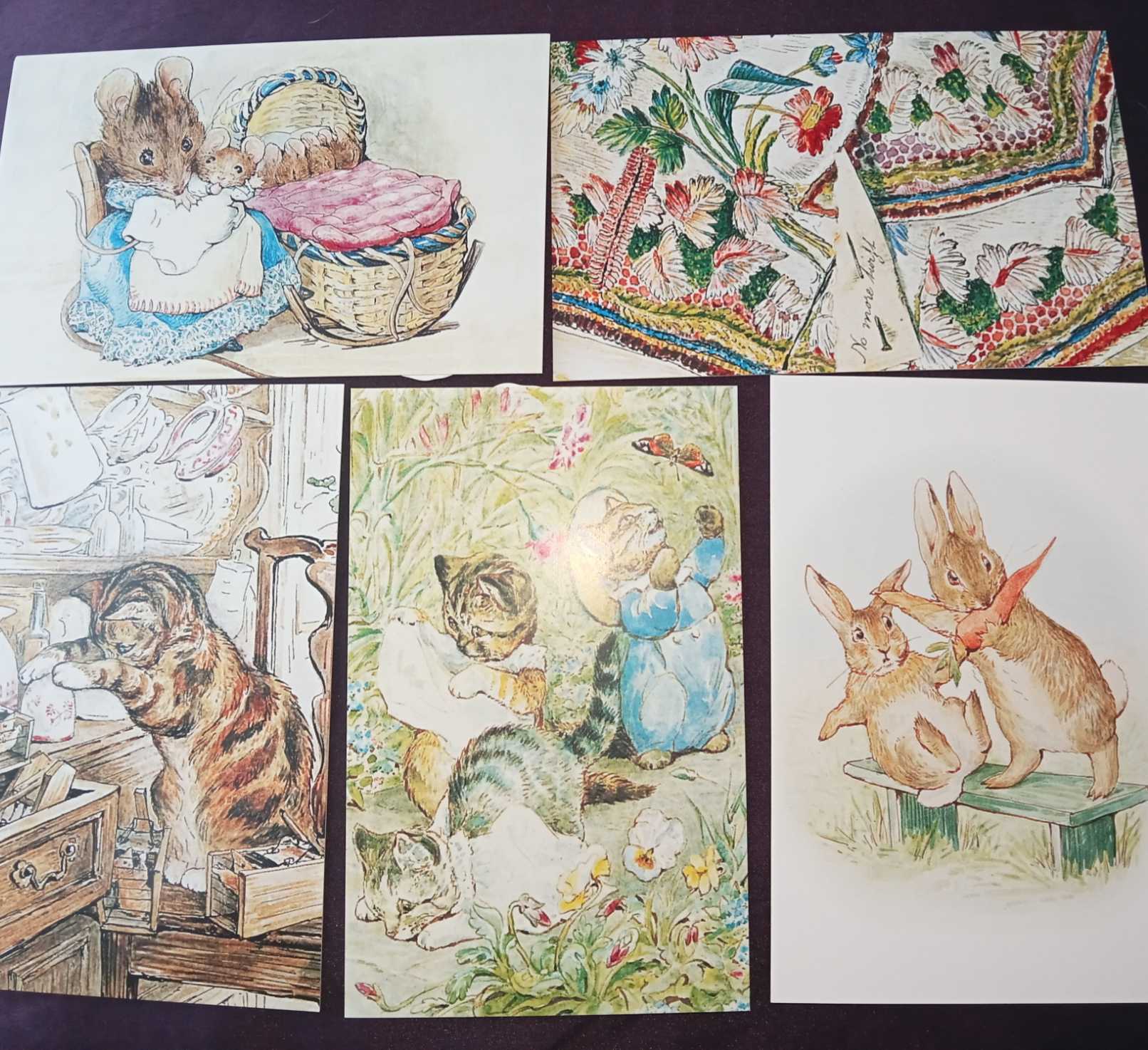
Following recommendations posted on our website, Rachael set out to find postcards that relate to her home country, searching for specific UK-themed postcards.


“Amongst the many packs of Big Ben and the Union Jack, I decided on something that, to me, is not only quintessentially British but that has brought me comfort many times in my life: Beatrix Potter stories. I grew up reading Beatrix Potter. As a child, my parents and grandparents would read them to me as bedtime stories. I would read them in my spare time, and I’ve always loved the drawings that bring the stories to life. I thought that the pictures of Peter Rabbit on the hunt for parsley, or Tom Kitten, Mittens, and Moppet mischievously playing in the grass in their best clothes, would bring a smile to the Defenders and help them forget about the war outside, even if it’s just for a moment.”
As we ask every postcard warrior to try at least one phrase in Ukrainian from our handy “cheat sheet”, Rachael admits that her Ukrainian “is very basic right now (I can ask for a cup of tea, though! I am British, after all!)”, so she has turned to an online translator to write most of her messages in Ukrainian.
“I want the message to have a more personal touch, like writing to a friend. Postcards to the Front relays on the website that the Defenders really appreciate it when foreigners use some Ukrainian in their messages, even if it’s just one sentence. And as there are many Defenders who may not speak English, it only makes sense to me that I put the effort into writing [as much as I can] in their mother tongue.”
Rachael has used both our site’s phrase translations page and DeepL online translator to write in Ukrainian on her postcards.
“I hope they’re accurate. Aside from asking for a cup of tea, my Ukrainian leaves something to be desired!”
When writing her cards, Rachael thinks about “who might receive the postcard, who they are, where they’re from, and what their life was like before the war. I think about how they’ll have families and will be missing them terribly. I think about how they must be feeling, wanting this war to end and to return to their families, to live peacefully. I offer up my thoughts, and I pray for them that this awful war ends and they can return safely to their lives and to their families.”
Each of these thoughts can be formed into meaningful words of support to a Defender.
And while she admits that “I can’t claim to know what living or fighting in a war is like,” Rachael can imagine how terrifying it must be.
“I know the effects of war, with my own grandparents growing up during the last world war, and my great-grandfather being a soldier who survived the evacuation of Dunkirk. My grandfather, his son, would tell us how the war had affected his father, who returned, like countless men, traumatized. I learned from him that the horrors of war and how they can affect someone can never be understated or dismissed.”
“Feelings of isolation are common amongst soldiers all over the world. If there’s any way I can lessen that feeling by sending handwritten messages of support to the people risking their lives to defend their homeland (and in turn, surrounding countries), I am more than happy to write to them.”
Ultimately, Rachael hopes that people “don’t forget about Ukraine. I know a lot is going on in the world, and it can feel overwhelming, but please don’t forget about them. Gestures don’t have to be grand to make an impact … do what you can in your free time or say a prayer if you’re the praying kind; it can make a difference. There is a lot of cruelty in the world, as sadly, many of us know all too well. It’s easy to forget compassion and, especially in war, to lose our humanity. Try your best not to. Compassion is an act of resistance.
For the Defenders: this war has made you soldiers. It’s your humanity that makes you heroes.”

Please continue to tell others about this project. Ask family and friends to write cards. Involve your children and grandchildren. Defenders especially appreciate postcards with drawings from children.
Share our website – postcardstothefrontcanada.com * Subscribe
Follow us on Instagram and Facebook.
Not sure how to get started? Check our “How to send a postcard … ” page, and our Ukrainian phrases page. Maybe you want to organize a group of family, friends or others to write postcards? We have a page with suggestions about How to Run a Postcard-Writing Workshop.A postcard message of support to a Defender of Ukraine is “a little bit of happiness” on a hard day.
~~~
As Nadia in Zaporizhzhia region reminds us –
Postcard support gives strength and courage.
Your turn
Send a postcard of your own
Every card written in Canada reaches a defender in Ukraine. Here is exactly how to write and mail yours.
← Previous story
Next story →
From the mailbag
Leave a Reply