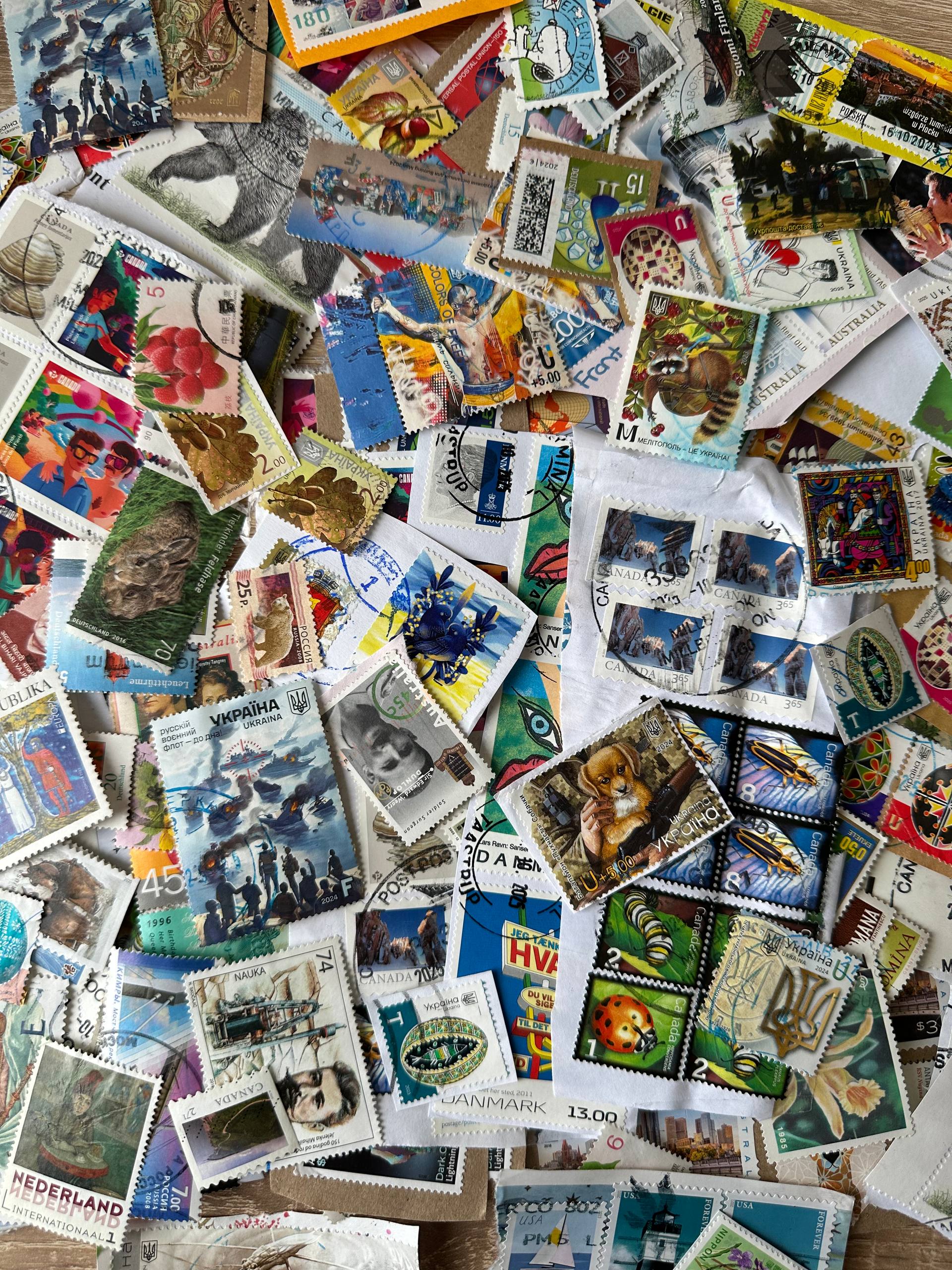
In January 2025, we published an article in our newsletter about Ukrainian friend, Irena Markova, who made it her mission to collect postage stamps to support the research work of the Bone Cancer Research Trust (BCRT), located in the United Kingdom.
After Irena’s passing from cancer in summer 2025, we received a message from Tamara at home base that Alyona, a friend of Irena, had decided to carry forward Irena’s legacy of support of the BCRT.
Before the full-scale invasion of Ukraine, Alyona lived an ordinary life in her birthplace city, Kyiv, that she describes as “a city full of beautiful places and diverse events. Many people are very different from one another, yet each of them is interesting in their own way.”
The ordinariness of Alyona’s days included “going to work, meeting friends, making plans, traveling abroad, going to the theatre, reading, etc. I had hopes and plans for a good future. Life felt stable, and I thought a lot about different things — my personal growth, how I could develop myself, and how I could be useful to my community. I felt confident about the future.”
Now, more than four years after russia’s full-scale invasion of Ukraine, Alyona reflects that “from the outside my life may look the same as before. I go to work, I meet with friends, and I continue to pursue my hobbies. But that is only how it looks. Because each of these activities can be interrupted at any moment by a missile or drone attack from russia. An air-raid siren can catch me while I am on my way to work, having breakfast\dinner, meeting friends, while I am walking in the park or more often in the middle of the night. This is a life lived in constant anticipation, in a constant state of readiness, knowing that whatever you are doing right now can be interrupted by an air-raid siren because of a missile attack.”
Alyona’s life, like the lives of every Ukrainian, has shifted from carefree days when she felt confident, to days when survival strategies are paramount.
“The war has filled my life with unpredictability and instability, with uncertainty about my future and even about tomorrow. I feel increased anxiety for my loved ones and my family, and I constantly worry about my friends who live in other cities. I closely monitor the situation every day, checking for missile or drone attacks in my city and in the cities where my friends are. I am always making sure that they are safe.”
Did you know that you Ukraine tracks and publishes daily drone and missile attacks on a variety of interactive maps, such as Alerts in Ukraine? These maps take doom scrolling to a whole other reality level!
“The realities of life during war always make their own adjustments. I’m trying to plan some things, but you don’t know whether you will survive the night, because of a missile or drone attack.”
“Death has become a constant presence,” Alyona stressed.
“You encounter it so often that even the loss of someone you did not know personally—but who was a Defender—affects you deeply. You understand that this person gave their life to protect the country, their family, and people like me. Over the past years, I have attended funerals of Defenders I did not know, yet their deaths feel personal, because they died so that our country could continue to exist. Living with this reality is extremely painful.”
“At the same time, I deeply admire Ukrainians—their strength, their willingness to help one another, and their determination to support those in need. We strive to continue living a normal life despite everything that is happening. This resilience is incredibly moving and inspiring; it sustains you and keeps you from giving up, because you hold on to hope—the hope that one day everything will be alright.”
Looking back to early summer, 2024, Alyona recalls her friend, Irena, starting the initiative “Dobromarky” (translated as Stamps for Good).
“Irena was both a Postcrosser [a project that allows you to send postcards and receive postcards back from random people around the world], and a cancer patient. Irena wanted to support cancer research in any way she could and to do something meaningful to help others.”
Through the Postcrossing forum, Irena discovered the Bone Cancer Research Trust (BCRT), which stamp appeal project collects used stamps, sells them to collectors, and directs the proceeds to bone cancer research.
Alyona recalls that Irena was inspired by the work of the BCRT and decided to support the organization.
“She began collecting used stamps and reached out to other Ukrainian Postcrossers for help. She carefully prepared the stamps herself—removing them from paper and getting them ready for shipment—and covered the mailing costs with her own money.”
Sadly, in June 2025, Irena passed away after a long and courageous battle with cancer. After her death, Alyona felt it was important to continue her legacy and carry on the work she had started.
“Initially, I used my own stamps, but soon other Ukrainian Postcrossers began sending stamps to me, just as they had sent them to Irena. I have been—and continue to be—deeply touched and grateful for the support from our community.”
Most of the stamps that Alyona receives come from the Postcards to the Front project, though she also gets stamps from Postcrossers who respond to Alyona’s request for stamps as outlined in her profile.
“The Australian, Canadian and other caring supporters and postcard warriors from all over the world send signed postcards to Ukrainian Defenders, most often in envelopes covered in postage stamps. Tamara Levit, who receives these envelopes, carefully cuts the stamps from them and sends them to me. I then prepare the stamps for shipment to the BRCT.”
Further, Alyona observed, every [stamped] envelope filled with written postcards to the Postcards to the Front project, means that “caring supporters and postcard warriors are doing two truly wonderful things at once: supporting Ukrainian Defenders with heartfelt postcards and providing stamps that help fund bone cancer research.”
Since August 2025, Alyona has sent six envelopes with stamps weighing a total of 1,310 grams.


“When Irena was running this initiative, she handled everything herself. I remember wanting to send her used stamps and asking, ‘Is it okay if I send old stamps or ones still attached to envelopes?’ She would always say, ‘Yes, yes—send anything. I’ll take care of everything.’”
When Alyona decided to continue Irena’s work, she realized that she didn’t fully know all the details of how Irena managed the initiative.
“I reached out to the BRCT, and they kindly answered all of my questions. Now, when people ask me, ‘Is it okay if I send you old stamps?’ I find myself replying exactly as Irena once did: ‘Yes, send anything. I’ll take care of the rest.’ I hope she would be happy to know that her good deeds are continuing in her memory.”
At Postcards to the Front (Canada branch), we send our stamps in rotating order to BCRT (UK), Oxfam Stamp Program (Canada), and to Stamps for the Wounded (US). See addresses at the end of the article, along with Mary MacKillop Today (Australia).
This project has been important to Alyona “because it allows me to continue Irena’s legacy while also supporting cancer research. I hope that, in the future, new discoveries will help cancer patients cope with the illness, improve their quality of life, or delay the progression of the disease for as long as possible. I also hope that one day people will no longer lose their friends—kind, bright souls like Irena.”
As postage stamps make a difference in the lives of cancer patients, Alyona believes that “words of support are incredibly important for our Defenders. They are on the front lines, facing danger every day, and often cannot see that people in civilian cities think of them, and do their best to support them. We are deeply grateful for their courage and dedication, because in this war, many who were ordinary civilians just yesterday have shown extraordinary bravery, stepping forward to defend our country and our right to a safe, free future for the generations to come.”
Alyona believes that Ukrainians “feel immense gratitude and want, in whatever small way we can, to show our appreciation. We want Defenders to know that we recognize their sacrifices, that we honor their courage, and that we are endlessly thankful to them for risking their lives and health to defend the borders of our country and protect our future.”
One of Alyona’s friends is a Defender who received postcards, and he expressed how their messages were “very touching and meaningful for him. He told me that a few postcards he particularly liked, he kept with him and carries them wherever he goes.”
We’ve heard similar stories from others about the uplifting role that postcard messages have on morale at the front lines, including from Oleh Nikolenko, Consul-General of Ukraine to Canada in Toronto. Mr. Nikolenko told us last summer, after he wrote some postcards to Defenders at the Tridents & Tanks event held at the Canadian Tank Museum, that “many Defenders keep their cards in a pocket with them, as a talisman for their safety. Yes, they need weapons. They also need to know that the world has not forgotten them.”
Alyona agrees that Defenders need to feel that they are not forgotten. “Receiving a postcard from far away can be a powerful reminder that people around the world care about them and appreciate their sacrifice. Even a small message can bring comfort, strength, and a sense of connection during very difficult moments. I know that words of support mean a great deal to them. They are especially touched by postcards\letters written and drawn by children, and they often keep them as talismans for protection and safety.”
As for how the invasion of Ukraine has changed her thinking, Alyona said “it’s time to wake up from the illusion of the world before the war in Ukraine. What began in 2014, and even earlier in Georgia in 2008, has changed the global order forever. Russia has shown that it is possible to invade almost any country under any pretext, occupy its people, murder, rape, loot, destroy homes, wipe entire cities off the map, and commit atrocities in plain sight—without facing real consequences. Meanwhile, other countries continue to trade with russia, communicate, cooperate, and even plan future partnerships as if nothing has happened.”
From her perspective, the lack of accountability for russia’s actions makes it seem clear “that the old idea of a just and fair world no longer exists. Speaking the language of democracy to dictators is a futile effort—it is doomed to fail. The world must face reality and act decisively, or sooner or later, russia—or another country like it—will bring war to your country as well.”
Still, Alyona manages to retain some optimism.
“I hold a deep hope for a bright and peaceful future for Ukraine. I hope that every person and child held in russian captivity will be safely returned, and that Ukraine will be able to recover the bodies of those who were killed or tortured, so that families can finally mourn and say goodbye properly. I hope that Ukraine will reclaim all its territories, restoring freedom to every place under long-term occupation.”
And, she added, “I hope that russia will never again be able to commit the atrocities it has inflicted on Ukraine or any other country. I hope that the sounds of rocket strikes, drone attacks, and air raid sirens will become a thing of the past. And above all, I hope that Ukraine will be able to rebuild, thrive, and develop in peace, just like other nations, free to look toward a future full of promise and hope.”
Further, Alyona expresses deep gratitude “for the support and engagement of so many countries. Even small gestures, like postcards with messages of encouragement, are deeply touching, comforting, and give us strength. I am thankful to every person, every foreigner, who is doing something to help Ukraine today, who is helping to bring peace to our country. It is difficult to put into words the feelings that arise inside you when you receive messages of support from people in other countries. For me, it is especially moving to receive words of encouragement from people on other continents, far away from Ukraine, who nevertheless understand what is happening in my country. They actively support Ukraine and speak about what truly matters—that Ukraine does not need just an end to the war or any kind of peace, but a just and fair peace.”
But, she added, “having lived through this brutal experience, it is painful to watch countries hesitate or remain passive. Every delay, every act of indecision costs lives in Ukraine—and it brings the threat closer to your own borders. The world must understand that supporting Ukraine is not just an act of solidarity; it is a way to protect yourselves and prevent this aggression from spreading further. Action cannot wait.”
While postcard messages of support are very welcome, they are one part of the many ways that Ukraine needs support.
For example, Alyona asks anyone who can to “take other concrete action: provide humanitarian aid, support refugees, and help rebuild the country’s cities and infrastructure. Military support is also crucial. Standing in solidarity, raising awareness, advocating for Ukraine in international forums, and holding aggressors accountable are equally important. Every act of support strengthens Ukraine and helps protect freedom [for all].”
Once the day of peace arrives, Ukraine will continue to need support. For example, rebuilding Ukraine’s infrastructure and communities. “The war has destroyed so much—so many things that, sadly, can never be fully restored [such as historic sites]. But from this devastation, there is an opportunity to create something new, something better. Ukraine will need significant support, assistance, and resources to make this possible. The international community’s engagement can help turn destruction into renewal, and hope into reality, giving Ukraine the chance to rebuild a strong, thriving, and resilient future.”

Have used stamps that you’d like to donate to support a worthwhile cause?
Bone Cancer Research Trust
10 Feast Field Horsforth
Leeds, West Yorkshire LS18 4TJ
United Kingdom
Mary MacKillop Today
PO Box 1646
North Sydney, NSW 2059
Australia
ATTN: Oxfam Stamp Program
Oxfam Canada
39 McArthur Ave
Ottawa, ON K1L 8L7
Canada
Stamps for the Wounded
P.O. Box 297
Dunn Loring, VA 22027-0297
USA
Your turn
Send a postcard of your own
Every card written in Canada reaches a defender in Ukraine. Here is exactly how to write and mail yours.
← Previous story
Next story →
From the mailbag
Leave a Reply